
Mid-terms, holidays, and a hope of relief from the seasonal vagaries of September/October. October’s end brought a bout of downward volatility due to earnings from Alphabet, which fell 12% on its results, the biggest drop since its 2004 IPO, and Caterpillar, which fell 9% even after beating on earnings.
Looking ahead, we are focused on October CPI data on November 10th, Nvidia and Walmart earnings in late November, holiday spending estimates and the Dec 8th-9th Federal Reserve meeting, where markets currently expect another hike.
Midterms: US equity markets have a long history of positive returns in post mid-term election years. Since 1950, the S&P 500 has posted a positive total return in all 19 years following a mid-term election, averaging 20.9%. The range is wide, from 1.4% in 2015 to 37.6% in 1995, and this year does not fit the pattern of a weak mid-term year followed by a rebound.
A definitive answer from the elections, in this case a blue tsunami, has investors in a buying mood following the mid-terms. There may be information here about slowing down the pace of the AI buildout, since that was implicitly on the ballot, but a strong showing by Democrats is having a buoyant effect on risk assets. The strength of the gains by Democrats has indeed made this election a clearing event, and while the market as a whole rallied on the removal of uncertainty, data centers and defense stocks are weaker while healthcare and alternative energy are seen as beneficiaries.
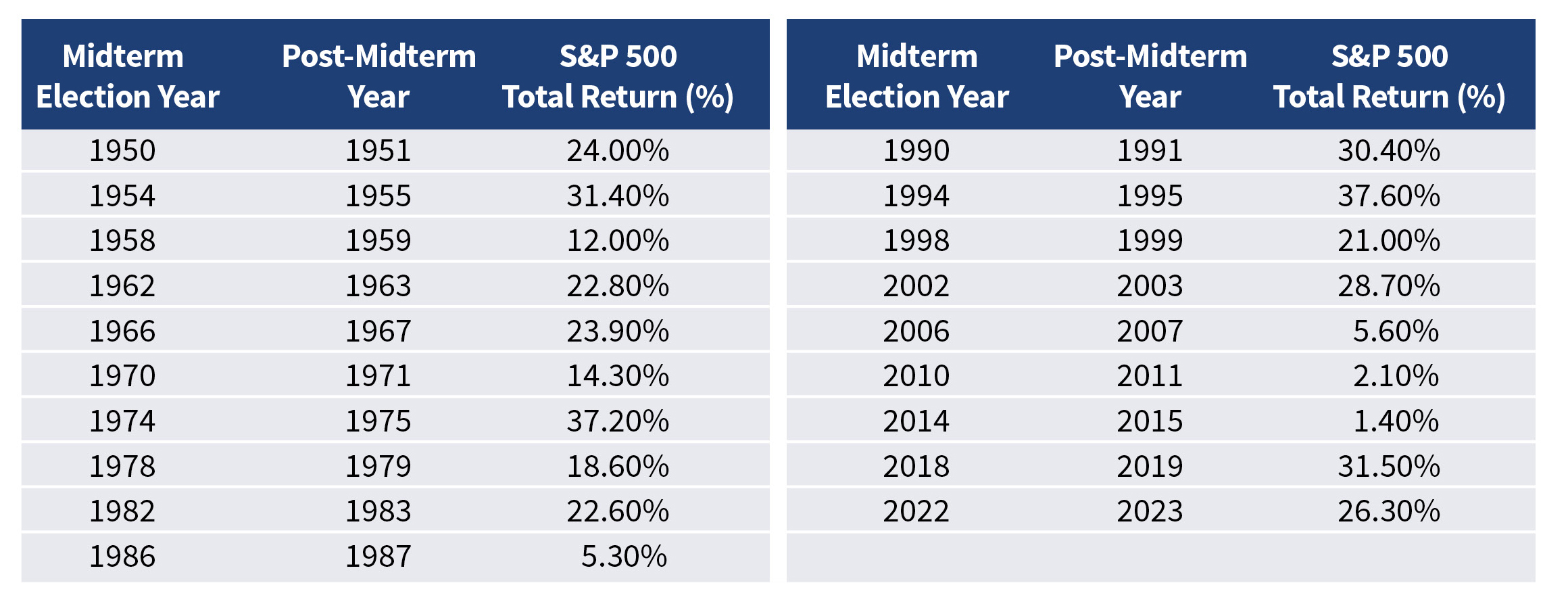
While the standard caveat that past performance is no guarantee of future results always applies, there is reason for optimism given the positive trends in the economy, strong GDP and a reasonably good labor market.
A good portion of the strong October 29th advance Q3 GDP report of 3.4% is due to the AI build out, which has grown to consume the cash generation of some of the world’s largest technology companies. From whence shall the next level of funding come? In the early stages of the buildout, this was not an issue. But as the numbers grow ever larger and the interdependence among the players grows more complicated, one would be forgiven for asking how this ever-expanding capex will generate an acceptable return on invested capital.
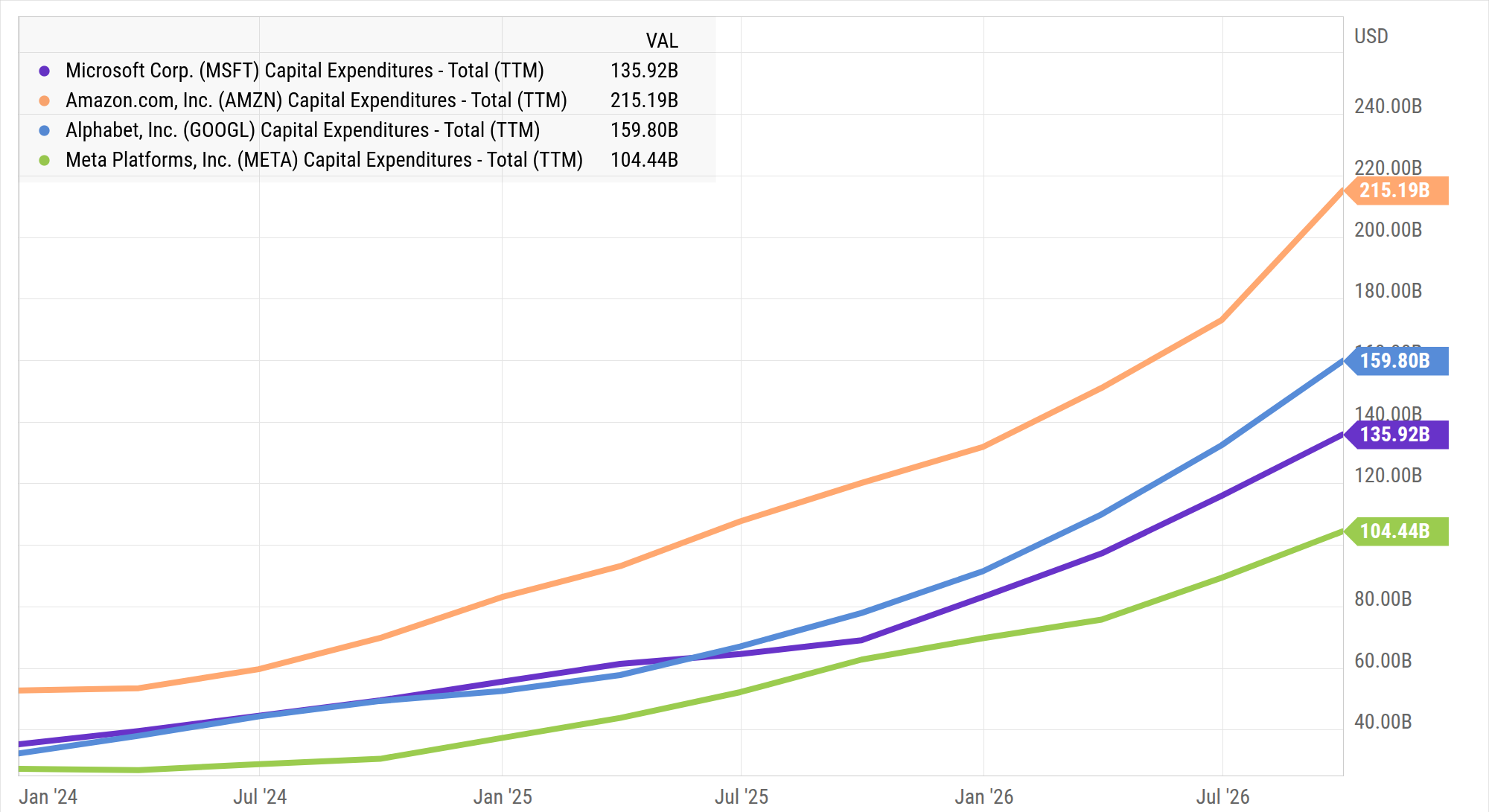
The election results may have some bearing on future AI capex. There are reasonable bull and bear arguments to make for the AI boom, and like most step changes in technology, what seems now to be the future may look very different in a couple of years. We are watching for capex guidance from the large players, and how investors react to that guidance. The blue wave carried with it some caveats on data center buildouts, and we will have to see how that affects current capex plans into 2027.
We have seen the reaction to capex growth shift from very positive to lukewarm as spending has risen. Apple seems to be a beneficiary of investor goodwill at the moment, and is famous for not getting caught up in the AI capex arms race.
We are also keeping an eye on the difficult combination of higher energy prices and component shortages due to the AI build out. The latter is creating inflation pressure in consumer electronics, which is generally an area that sees more deflation than inflation. While elevated energy prices can be mostly attributed to the current conflicts in Iran and Russia-Ukraine, the need for energy to power the data centers that are absorbing the components may prove longer lived.
This would argue for additional investor participation in the energy complex, and indeed we see opportunity across energy infrastructure as well as new technologies that will be utilized to help manage the surging demand for electricity.
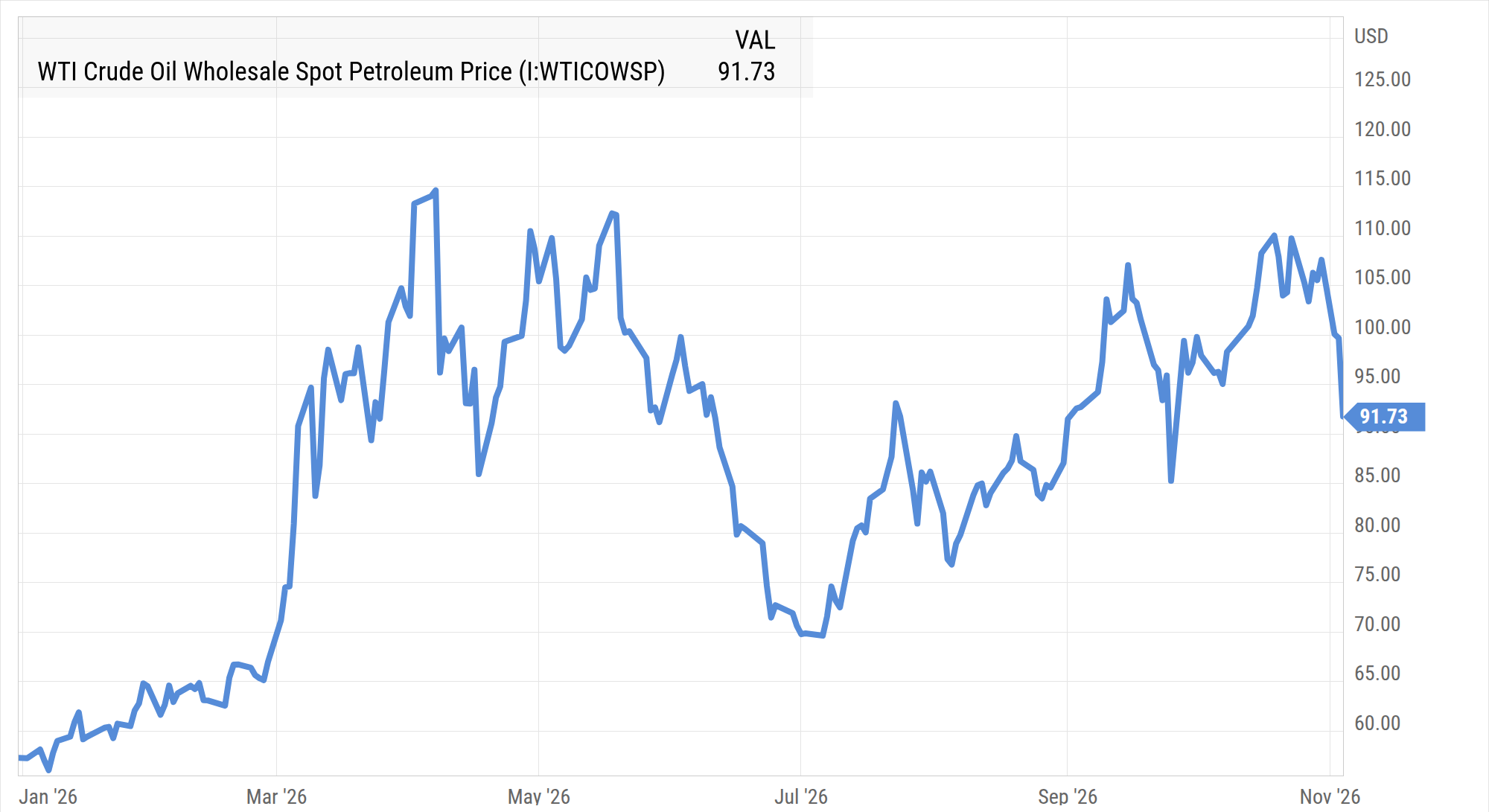
Higher oil prices combined with higher interest rates are a challenge for consumers, which is one of the reasons we are watching retailers’ earnings so keenly. Consumer discretionary stocks have had a difficult year, down 2.8% YTD vs. consumer staples up 17.3% YTD (both as of October 30th).
With the move higher in rates in early October, we took the opportunity to add some duration to our portfolios that hold fixed income, moving from an average duration of just under two years to closer to three. In a rising-rate environment, we will stay on the shorter end of the curve, and given the current inflation picture, the market anticipates the Fed may hike again in 2027.
While we do not expect to get definitive 2027 guidance until the fourth quarter earnings season begins early next year, we are listening for any hints as we head into year end.
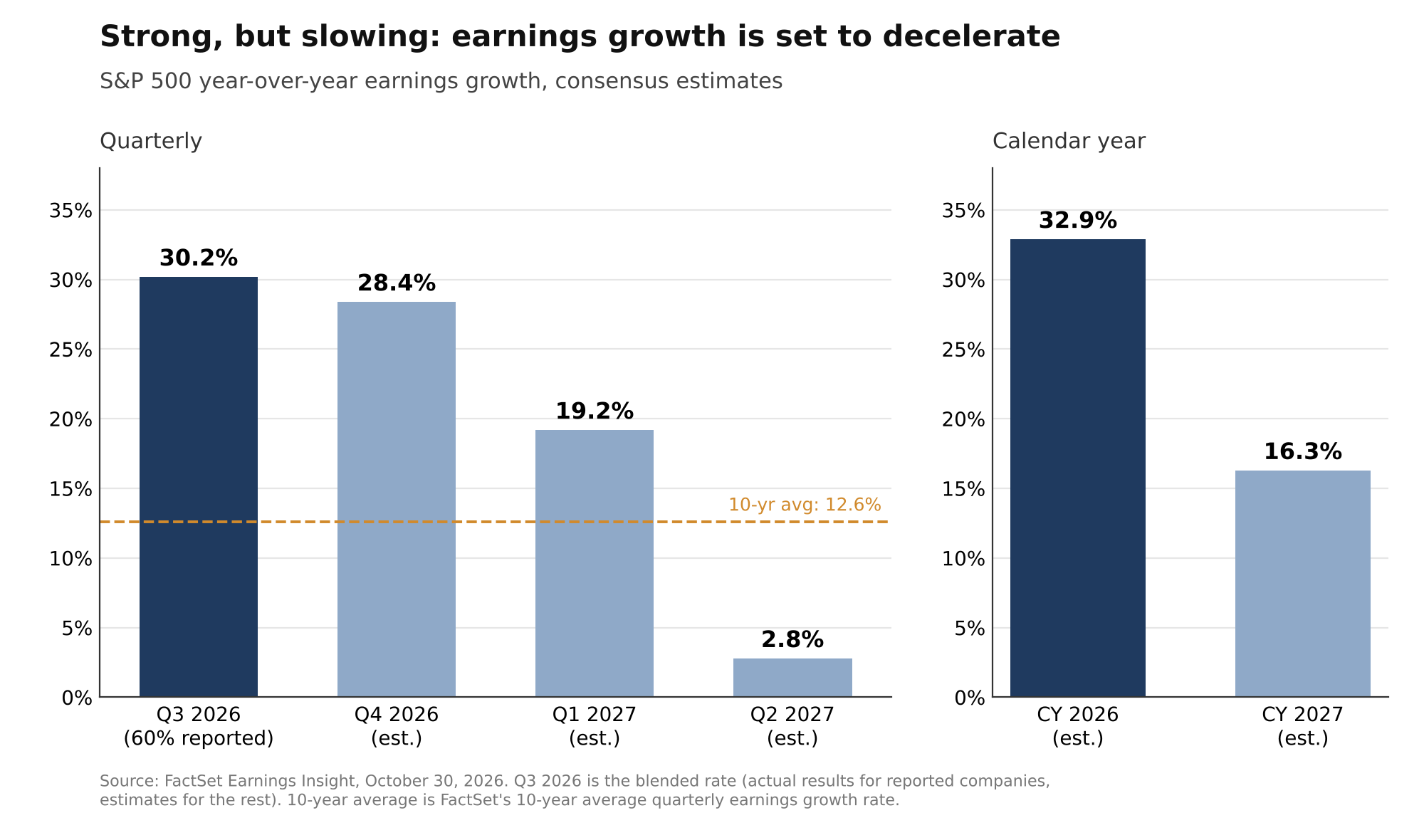
The phenomenal earnings growth in 2026 of over 30% is unlikely to repeat in 2027, although at the start of 2026 expectations were not for such high growth. Current consensus is over 15% for 2027, which is still elevated vs. the long run average. The multiple compression for the S&P 500 has also eased elevated valuation concerns. The 2027 consensus forward P/E for the S&P 500 of 17.9x is less elevated than the 20.9x for 2026, both as of November 2, 2026, according to Bloomberg.
The risk lies in the rate of change. When earnings growth slows from one year to the next, markets often react even if growth remains strong, and the tailwinds of heavy capex and high energy prices, at least as they relate to earnings, may be difficult to replicate.
We remain cautiously optimistic given the backdrop and are aware that the four-year bull market may see some volatility ahead. We are also watching how the major players will fund the AI buildout and are looking to the Anthropic IPO and news on OpenAI to gauge investor appetite for more spending.
We remain overweight healthcare, where valuations are reasonable relative to the broader market and the sector stands to benefit from AI through drug discovery, diagnostics and operating efficiencies. We also continue to see opportunity in energy infrastructure given the surging demand for electricity, and the post-election rotation into healthcare and alternative energy supports both views.
The information in this commentary has been obtained from sources believed to be reliable, but its accuracy and completeness are not guaranteed. The opinions, estimates and projections constitute the judgment of Alpine Saxon Woods and are subject to change without notice. This commentary is for information purposes only and is not intended as an offer, recommendation or solicitation for the sale of any financial product or service or as a determination that any investment strategy is suitable for a specific investor. Investors should seek financial advice regarding the suitability of any investment strategy based on the investor’s objectives, financial situation and particular needs. The investments or investment strategies discussed herein may not be suitable for every investor. There is no assurance that any investment strategy will be successful.