

Mid-Year Outlook 2026
What a long, strange year it’s been . . .
From a first quarter that felt like months to a second quarter that has flown by, investors and markets have had plenty to contend with this year. A war in the Middle East with no clear resolution, a change in Federal Reserve leadership, a backdrop of exceptional earnings that may or may not be overstating things, and an Artificial Intelligence buildout that may or may not have gone too far: It is forgivable to think that investors have a lot of contradictory information to manage all at once.
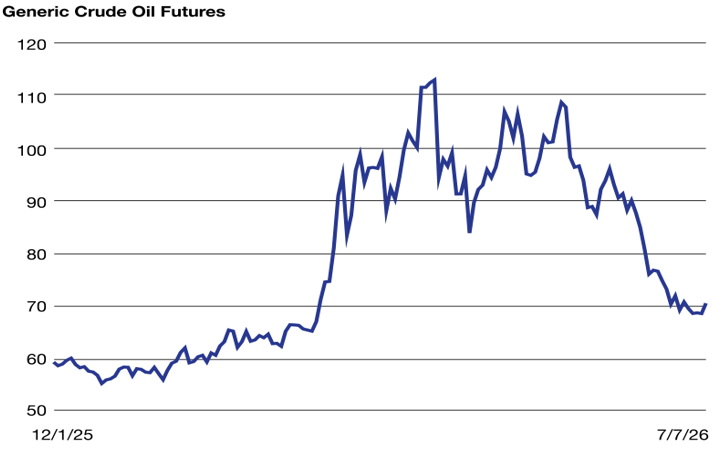
We can start with energy prices and the war with Iran. While it is clear the conflict is not “over” in the conventional sense of having a framework agreement accepted by both parties, shipping oil and other goods through the Strait of Hormuz seems to have resumed, even if at a slow pace. This appears to be the most critical element for investors and equity markets; the drop in oil prices was the clearest indicator of that as June came to a close.
A new Federal Reserve Chair, Kevin Warsh, gave US equity investors a bit of a scare by calling out a strict 2% inflation target in no uncertain terms, just as markets were anticipating a more dovish tone. Since oil was still at elevated levels during his first press conference, the market reaction was swift. The expectation for rate hikes as the next move, versus cuts, was immediately reflected in forward rates. The curve went from pricing in no hikes this year to potentially two.
Source: Bloomberg
The subsequent drop in oil prices, coupled with less robust employment data, has since eased those hiking concerns. Remarks by Chairman Warsh suggesting that inflation may be mitigated by lower oil prices reversed some of the equity market weakness that rate anxiety had introduced. The expectation for rate hikes was reduced quite substantially after the June payrolls report, and currently there are valid arguments for both hikes and cuts before year end.
We expect a “wait and see” approach will continue unless there are substantial, unexpected shifts in inflation or labor data. The drop in oil prices has created an expectation that inflation will moderate, while the weak payrolls report, both on an absolute level and via the drop in the participation rate, argues for potential cuts rather than hikes.
Much of the US equity market’s good fortunes have been held aloft by solid earnings that have been reported higher than the consensus expectations set as we entered 2026. One of the key questions about the stellar earnings picture is its sustainability. Because some of the biggest numbers are coming from areas like memory and other AI infrastructure bottlenecks, that type of earnings upside can be viewed as temporary. This concern dovetails with larger strategic questions surrounding the AI buildout and use cases: what exactly are investors, adopters and players in the AI space expecting?
Source: Bloomberg
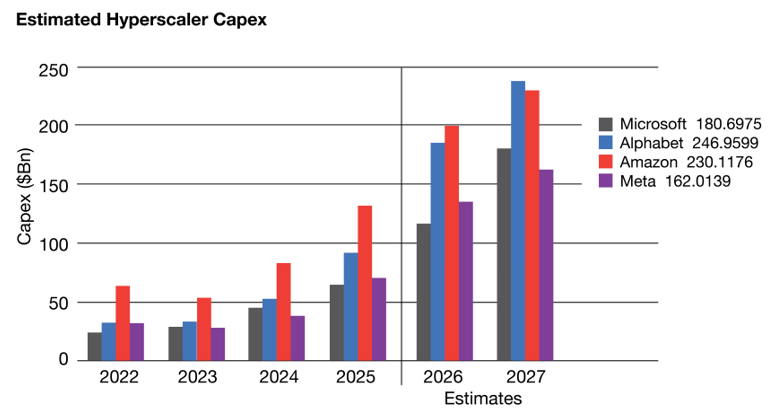
The biggest story for equities in 2026 so far has been the recipient companies of the massive capex needed to keep the AI juggernaut moving. Semiconductors and memory suppliers have been the prime beneficiaries of bottlenecks in the AI buildout, while investors have walked away from the spenders – the hyperscalers and Mag 7, which have been nicknamed the “Lag 7” in 2026.
With Meta's announcement that it may have compute processing available for sale, questions about the scarcity story for compute come front and center. The combination of new technology and a frantic capex race to stay relevant has been a driver for both earnings and markets; any wavering or swerving from that path creates uncertainty. How this plays forward could have major repercussions for both earnings expectations and potential sector rotation.
This is not the first narrative shift investors have had to contend with, but it could alter the buildout of the AI ecosystem. There is a flipside to this argument: the possibility that Meta is positioning to compete more directly with the hyperscalers by monetizing excess capacity. At the moment, it is too early to tell. Some maintain that the hyperscaler capex narrative remains intact, characterizing Meta's move as opportunistic rather than defensive. Others are less sanguine, suggesting the market should treat any reduction in compute demand as a yellow flag for the semiconductor and data center supply chains.
It’s too soon to tell if this is a harbinger of overcapacity or just the story of one company making another large directional shift. In recent discussions, we are learning more about the varied business models of AI – not all compute is created equal, nor are all semiconductors. The switch from memory demand being driven by consumer products like PCs and phones to data centers may be profound enough to have an effect on the cyclical nature of the industry, possibly making this particular concern a tempest in a teapot.
Equity markets love a good story, and the heralding of AI as a secondary industrial revolution has done a lot of heavy lifting for positive market sentiment. How this story continues to play out and evolve will be vital to both the market as a whole and portfolio construction. We do see the potential for some rotation back to the hyperscalers, as Meta’s price action after its announcement seemed positive. We also know that major changes in technology are rarely linear, and we are likely to see further shifts in both sentiment and narratives ahead.
That rotation creates opportunity. Healthcare and financials, sectors that have been in the shadow of the technology story, are beginning to reassert themselves on the strength of their own innovation, benefits from AI initiatives, and recent regulatory relief. We see other beneficiaries of potential AI productivity gains and lower computing costs in defense, automation and robotics, leisure and travel, and non-AI infrastructure. We will continue to position portfolios for both the continuation of the AI trend and the emerging stories that may define the second half of 2026.
The information in this commentary has been obtained from sources believed to be reliable, but its accuracy and completeness are not guaranteed. The opinions, estimates and projections constitute the judgment of Alpine Saxon Woods and are subject to change without notice. This commentary is for information purposes only and is not intended as an offer, recommendation or solicitation for the sale of any financial product or service or as a determination that any investment strategy is suitable for a specific investor. Investors should seek financial advice regarding the suitability of any investment strategy based on the investor’s objectives, financial situation and particular needs. The investments or investment strategies discussed herein may not be suitable for every investor. There is no assurance that any investment strategy will be successful.