
That discordant noise you hear is coming from the bond market.
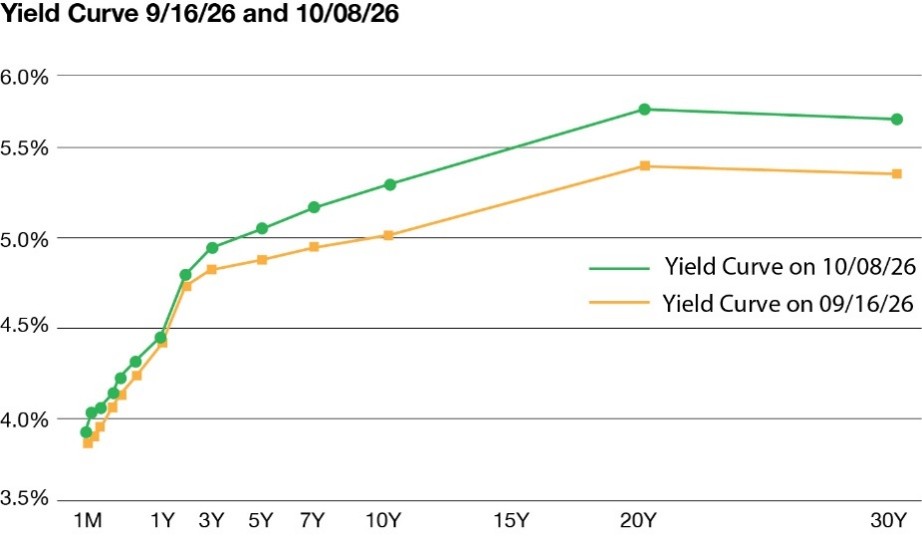
After months of volatile but increasing oil prices and a steady drift higher in yields, the 5% line has now been crossed across the curve, from the 5-year to the 30-year. We have been in the camp that a rate hike (or two) might not slow the juggernaut of AI capex, but a shift higher in the entire curve and a rising long end may be more problematic for the rest of the market. After the 25 basis point rate hike in September, odds for October and December hikes increased dramatically. October odds have since declined, but the odds for a second rate hike in December are currently over 80%.
Elevated oil prices driving inflation are certainly a proximate cause of rates moving higher across the board, and the move is a global phenomenon. A string of higher-than-expected global Purchasing Managers' Index (PMI) numbers added to concerns of a "too hot" economy and a jump in rate hike odds added pressure to bonds. Yields moved higher across the curve. After staying short for the last few years, we see this move as an opportunity to extend duration at what we believe are increasingly attractive levels (chart as of 10/06/26).
The textbook setup for equities in a rising rate environment is challenging. The traditional trade of higher rates pressuring technology is getting less traction in this cycle, but there are concerns about how much debt the technology sector is taking on, and those concerns may escalate as rates go higher. Below the technology giants, the market does not look as robust, with many stocks trading below their 200-day moving averages. The chart below tracks the change in the top 10 stocks in the S&P 500 vs the index itself, showing how important those larger companies have become as a share of growth.
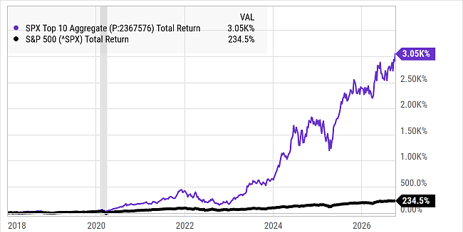
The top-heavy nature of the S&P 500 and the Nasdaq as capitalization-weighted indices has kept headline levels near highs on the back of the technology sector, while other sectors are showing signs of strain. The narrowness of this market has drawn comparisons to prior periods of concentrated market leadership, although the underlying economic and market conditions can differ significantly across periods, and the push for AI capex is drawing criticism as some market participants warn of potential dangers.
With all that said, cyclical companies have been positive in their forward outlooks. Our recent conversations with companies in the short-cycle industrial space have indicated an acceleration of demand rather than a slowdown.
Much waxes and wanes with the oil story, and relief there could go a long way toward easing the energy-driven inflation that has been creeping through the economy. Recent increases in shipments through the Strait of Hormuz may provide some relief to energy markets if the trend continues. But narrow market participation, combined with a potential margin squeeze due to higher energy and input costs, is one of the near-term worries. So far, price increases and cost savings elsewhere have been able to offset rising costs.
Earnings continue to be the market story, and the AI build-out is contributing meaningfully to earnings growth. S&P 500 earnings for 2026 are projected to be up over 30%, with technology and energy large contributors to that growth. The expectation for 2027 is currently a more modest 15%, still very good on a historical basis. The AI story matters so much because it is driving the growth that has given investors comfort even as energy prices have been sharply volatile to the upside.
At the start of the year, projected growth in earnings for 2026 was 14-15%, so investors may also expect the 2027 numbers to move higher. The spending race for AI has benefited not just technology but the industrial sector as well, and while these stocks have suffered due to higher interest rates, the rare combination of higher rates and higher expected earnings has led us to view the group more favorably following the pullback.
The start of October has brought some relief from higher oil prices, but the damage to the refined product market and global diesel shortages may have a lingering negative effect. Finally, the upcoming election cycle now seems to favor a split of power between Democrats and Republicans, a scenario that has produced varied market outcomes historically and whose potential market impact will depend on the broader economic and policy environment.
The information in this commentary has been obtained from sources believed to be reliable, but its accuracy and completeness are not guaranteed. The opinions, estimates and projections constitute the judgment of Alpine Saxon Woods and are subject to change without notice. This commentary is for information purposes only and is not intended as an offer, recommendation or solicitation for the sale of any financial product or service or as a determination that any investment strategy is suitable for a specific investor. Investors should seek financial advice regarding the suitability of any investment strategy based on the investor’s objectives, financial situation and particular needs. The investments or investment strategies discussed herein may not be suitable for every investor. There is no assurance that any investment strategy will be successful.